Ryan Call, contrary to the belief of of some, is not a coward for the way that he has handled State Senator Vicki Marble's remarks on race and chicken.
Marble is a big girl and chose to run under the GOP aegis for a state senate seat. When she got the seat she knew or should have known that the left would be gunning for her. In spite of that, she made stupid remarks that have embarrassed the GOP nationally.
Were the remarks intentionally offensive? No. But when you hold office that isn't the standard. You don't make remarks that are even unintentionally offensive, especially this degree of offensive, especially when the left is coming for you at any opportunity. Marble broke that standard and forced Ryan's hand.
Another quick point of advice: Rhonda's handling of this situation was poor and she should be called out for that. However, if you start saying things like "jump suit Rhonda" or "Rap Sheet Rhonda" you are going to get accused of dog whistle racism. Stay on point: Rep. Fields could have chosen any numbers of ways to handle Marble's remarks. She could have spoken with Marble in private about them. She could have had legislative leadership speak privately. She could have asked for clarification as to what Marble meant. Instead of doing any of those things she decided to publicly humiliate Marble for an unintentional comment. That was her choice, she alone was responsible for it, and can be judged for it by a person of any race/ethnicit
Friday, August 23, 2013


Friday, August 09, 2013
Jax Bubis Causing Some In EPCO GOP To Question Endorsement Protocols
This is republished by permission from former El Paso County GOP Division Captain Bob Clark, author of following comment here, who was in turn responding to this ColoradoPols article:
I'm about to criticize two of my favorite elected officials. It sucks but it would be disingenuous if I attacked everyone involved except them.
On ColoradoPols is an article linking former Candidate Jax Bubis to sovereign citizen's movement. You know - the people who believe they can print their own money partly because the United States of America and/or Colorado no longer exists in their eyes. Yes, Coloradopols is a very liberal site, but I consider this a very fair written article (at least until the end when they started jabbing the whole GOP).
What is truly damning in the article though is the list of her endorsers:
Sen. Owen Hill
Sen. Ted Harvey
Sen. Kent Lambert
Sen. Vicki Marble
Sen. Randy Baumgardner
Former Sen. Dave Schultheis
Rep. Janak Joshi
Rep. Chris Holbert
Rep. Justin Everett
Rep. Steve Humphrey
These aren't small timers in the GOP. These are state players including two U.S. [Senate] Candidates. You'd think these people would have done their due diligence. It's not like it was tough to do - the day Jax announced I was receiving calls about what people where finding out about Mrs. Bubis.
So what this whole mess plus the Beantown Heat stuff shows is a lack of checking a person out before endorsing them by the people who endorsed her. Now, some of these people I have a huge respect for, yet they need to start doing a better job of vetting people. What will be the result of this? Simple: Democrats will use whatever this lady does to hurt those who endorsed her. I wonder how many of these endorsers also endorsed Dan Maes? Starting to see a pattern here.
Former El Paso County Division Captain Bob Clark
Saturday, May 04, 2013
Why Does Nathan Silver's Interactive Map for 2012 Not Seem To Match A Prior NYTimes Post?
Nate Silver has published a handy interactive map for the impact of various minority groups in past/future elections. Relying on that map, Byron York published the following article which claimed, using Nate's map, that "Romney would have had to win 73 percent of the Hispanic vote to prevail in 2012." I checked Byron's results against Nate's map, and it appears Byron is correctly utilizing it. In fact, from playing with the Map's numbers and holding everything else constant for the 2012 election, here is the minimum number of the Hispanic votes that the Map claims Obama was required to obtain to win the following states:
Ohio - 25% and tossup at 24%
Virginia - 37% and tossup at 36%
Pennsylvania - 29% and tossup at 28%
Colorado - 52%
Florida - 69%
These numbers though seem to conflict with a prior NYTimes Nov. 20, 2012 post, which utilized Exit Poll data reported by Edison Research. That post said different numbers of Hispanic voters were required for the Dems to claim various states that they in fact carried. Those states, and the number of Hispanic voters that it claimed Obama need to carry them, are as follows:
Ohio - 22%
Virginia - 33%
Pennsylvania - 37%
Colorado - "just over 58%"
Florida - 58%
There is a pretty substantial difference with what the Map and the Nov. 20, 2012 article is reporting was needed, for some of these states. Because I am not a stat professional and could easily be making a mistake I am not aware of I have posed the following questions to Nate Silver on his 538 blog and am hoping for a clarifying answer:
(a) Am I/Byron York using your interactive map correctly?;(b) Am I interpreting your interactive map correctly?(c) Was the Nov. 20, 2012 New York Times post incorrect?;(d) Is your map incorrect?; and/or(e) Any other explanation.
For if it turns out that that there is a mistake in the Nate's interactive map, Byron and his allies might need to rethink their use of it to diminish the importance of the Hispanic vote in the 2012 election.
Tuesday, April 23, 2013
ColoradoPols Needs To Apologize To Colorado Secretary Of State Scott Gessler
Over the past few days, ColoradoPols, a prominent Colorado political website, has run articles attempting to tie Colorado Secretary of State Scott Gessler to an allegedly racist mailer. Because the mailer was not only not racist, but also because there is not a shred of evidence remotely tying Gessler to it, Colorado Pols owes Gessler an apology.
1. Background
In the updated version of its original story, "Hackstaff Gessler Mailer Targets GOP County Clerks", ColoradoPols drew attention to a mailer that Citizens For Free And Fair Elections ("CFFE") sent out. Specifically, ColoradoPols noted that: (a) the mailer attempts to hit Mesa County Clerk Sheila Reiner on her support for House Bill 1303, the Colorado Voter Access and Modernized Elections Act"; (b) the mailer "Photoshopped out [an] African-American woman in the original photo"; (c) that this photoshopping added an "ugly dimension" to the story; and (d) that the address of Gessler's former law firm, Hackstaff Law Group, was listed on the mailer. Subsequently, ColoradoPols ran two more articles. The first reported that the NAACP had expressed serious concern regarding Secretary of State Scott Gessler's close ties to a group that sent the photoshopped mailers. The second claimed that "[i]t's absurd . . .to suggest anything other than a racist motive for editing the photo in question". By virtue of this reporting, ColoradoPols has created an implicit narrative: that Colorado Secretary of State Gessler is tied to a racist mailer. The problems with such a narrative is that it is baseless, dishonest, and wrong.
2. Gessler Should Not Be Tied To A Mailer He Had No Part In Making
Let's start with how Gessler gets tied to the mailer in the first place. Prior to campaigning in 2010 and serving from 2011 to the present day as Colorado Secretary of State, Gessler worked at the Hackstaff Law Group which was then known as Hackstaff Gessler LLC ("Hackstaff"). Hackstaff, in turn, is the registered agent for CFFE. Not the strategists. Not marketers. The registered agent. In other words a position that accepts correspondence and service of process.
3. The Mailer Was Not Photoshopped For Racist Reasons
Beyond that though, there were always problems with the theory that racism was employed as the basis for photoshopping. Namely, what possible political gain would a GOP group have by removing African-Americans from a mailer? And even if there was some theoretical (and practically impossible to see) gain from photoshopping, how could that possibly outweigh the risks of detection? For these reasons, the theory that racism was the reason for doing the photoshopping never made sense. On close examination of the photoshopping, it is now clear why it made no sense - because racism was never the reason for the photoshopping in the first place.
Let's take a look at the portion of the photoshopped picture in question (courtesy of ColoradoPols) and compare it with the original version:
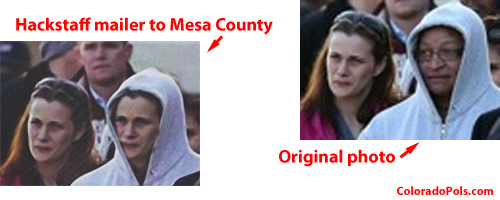
It's clear an African American was photoshopped out. What is also clear is that the face photoshopped in is identical to the face immediately to its left. In other words, the picture clumsily attempts to make it appear as if the Caucasian is attempting to vote twice, and thus fit with the theme of impending voter fraud that it claims the Colorado Voter Access and Modernized Elections Act would result in.
In fact, further buttressing this position is the complete photoshopped image (again courtesy of ColoradoPols).
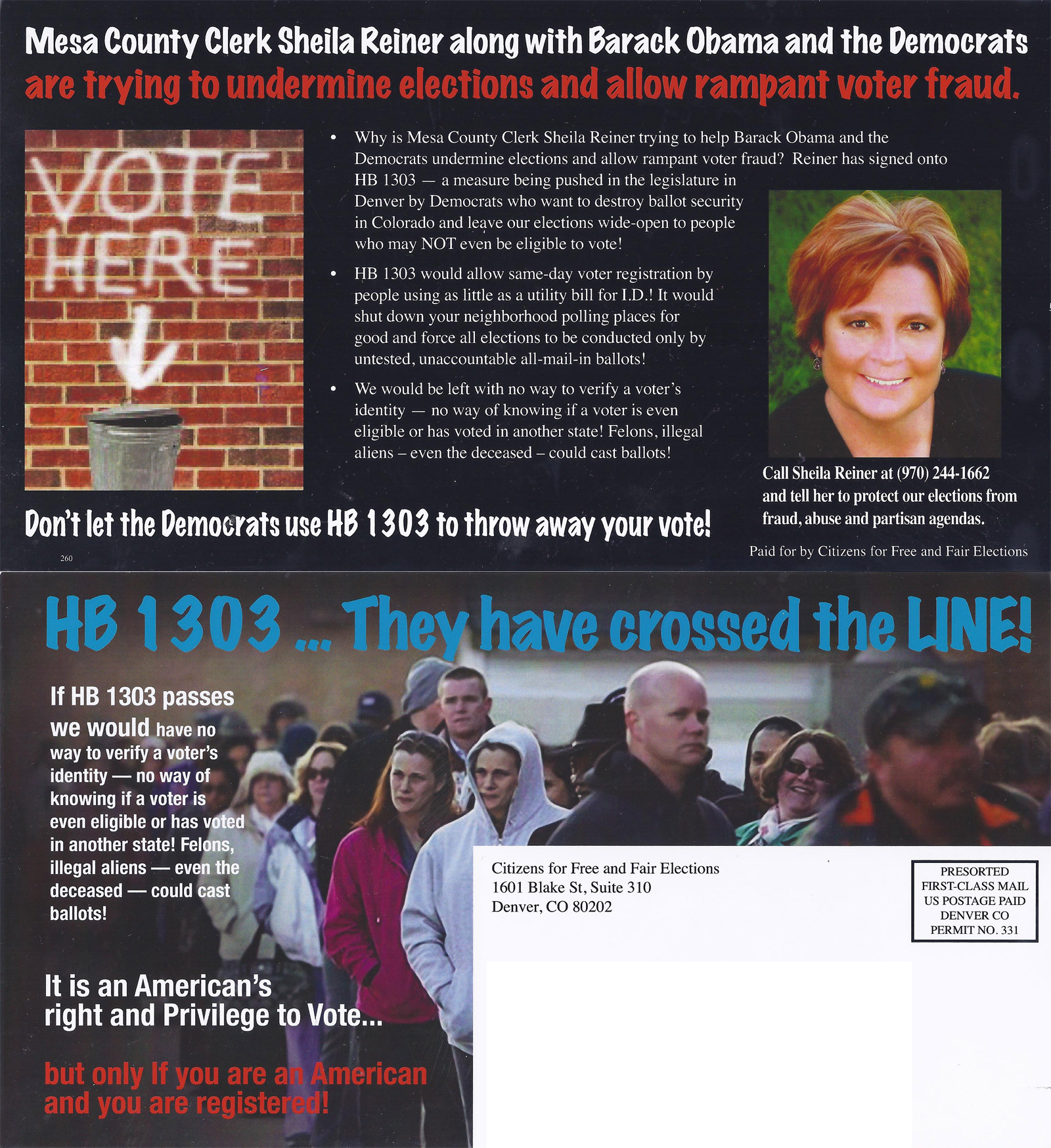
If one takes a look around the photo one will find....wait for it...African Americans. So if the point of the photoshopping was to remove African Americans, why did it leave African Americans? Simple - that was never the photoshopping's point in the first place. In fact, if the mailer was actually racist it wouldn't have photoshopped African Americans OUT - it would have photoshopped them IN as a crude attempt to try to show minorities voting twice.
4. ColoradoPols Should Apologize
So what we have here is Gessler getting tied to a mailer solely because Hackstaff, a firm Gessler hasn't worked at in years, accepts mail for the people that put it out. Sort of reminds one of charts, where Glenn Beck attempted to tie Obama to Communists. Not only unpersuasive, but the kind of McCarthyism that a site like ColoradoPols should be ashamed of advancing. Especially when the mailer itself wasn't even racist in the first place.
It is hatchet job stories like this that give alternative news media sites a bad name. ColoradoPols has spent the better part of two days unjustly tarring and feathering not only Gessler, but also Hackstaff Law Group. Such irresponsible labeling risks unjustly ruining reputations and damaging professions. For this reason, responsible reporters would never have shot off ColoradoPols stories, in the form they were in, without asking questions and doing due diligence first. Because ColoradoPols at best failed to do such due diligence it should, if it has any decency, immediately apologize and issue retractions for these stories.
Tuesday, July 31, 2012
Federal District Court Breaks New Ground In Allowing TABOR Lawsuit To Proceed
Yesterday in Denver, U.S. District Judge William J. Martínez ruled that the lawsuit against Colorado’s Taxpayer Bill of Rights (known as “TABOR,” and which “limits state spending and bars lawmakers from raising taxes without a vote of the people”) could proceed partly under the theory that it violated “Republican Form of Government Clause” of Article IV, Section 4 of the United States Constitution. In so ruling, Judge Martínez boldly went where no Supreme Court Justice had gone before – she found that a case alleging a “Republican Form of Government” violation as its theoretical basis was justiciable (i.e. the Court could rule on it as opposed to being required to immediately dismiss it). Many cases, in fact, had held the opposite. See, e.g.,Luther v. Borden, 48 U.S. (7 how.) 1 (1849), Pacific States Tel. & Tel. Co. v. Oregon, 223 U.S. 118 (1912); Baker v. Carr, 369 U.S. 186 (1962). It will be interesting to see whether there a possible future appeal on this point reaches the same result. It will also be interesting to see if any conservative legal groups/attorneys take the ruling as an invitation to challenge taxing and spending mandates approved through the initiative process that progressives have backed. See, e.g., (courtesy of the Reply Brief in the case) Colo. Const. art. IX, § 17 (Amendment 23, added by initiative in 2000); art. X § 21 (Tobacco Tax, added by initiative in 2004).
The Case is Kerr et al. v. Hickenlooper, No. 11-cv-1350-WJM-BNB (D. Colo.) More information on the progress of this case, including pertinent court filings, can be found here.
Elliot Fladen is a graduate of Stanford Law School and an attorney practicing law in Colorado Springs at The Fladen Law Center. Nothing in this column constitutes legal advice or begins an attorney-client relationship with Mr. Fladen.
Wednesday, July 25, 2012
Musings On Psychiatric Liability For The Aurora Shootings
According to a FoxNews.com report, the alleged Aurora batman shooter James Holmes sent a notebook “full of details about how he was going to kill people. . . . [with] drawings of what he was going to do in it -- drawings and illustrations of the massacre” to a University of Colorado psychiatrist before the attack. The psychiatrist, however, did not receive the notebook as it had been sitting unopened in a mailroom for almost a week. Additionally, the FoxNews report could not verify whether the shooter had a prior relationship with the psychiatrist to whom he mailed the notebook. These facts now raise questions as to what liability, if any, may ensue from the mailing of this package and the psychiatrists failure to receive it. This blog post will seek to address those questions in an informal/nonlegal advice manner. Again and as usual, nothing here constitutes legal advice, so please consult with an attorney before relying on any of it.
Before beginning my analysis, I'm going to flag several assumption I am making which may or may not be factually and/or legally accurate. First, I will be assuming that Mr. Holmes was previously the psychiatrist in question's patient. Second, I will be assuming that the psychiatrist had a legal duty to open the mail that Mr. Holmes addressed to him. Finally, I will be assuming that the psychiatrist's failure to open said mail will lead a reviewing a Court to deem that he read the notebook in question. Under such assumptions, the psychiatrist may in fact have liability to the victims of the shooting if the notebook's contents either (a) showed a serious threat of imminent physical violence against the specific patrons attending the theater on the date and time in question; or (b) were sufficiently clear to create an obligation place Mr. Holmes under an immediate 72 hour psychological hold.
To start the analysis, C.R.S. § 13-21-117 generally absolves psychiatrists from liability to third persons “for damages in any civil action for failure to warn or protect any person against a mental health patient's violent behavior.” The statute similarly protects psychiatrists for their “failure to predict such violent behavior.” The statute, however creates exceptions to this absolution of psychiatrist liability when: (1) the patient has communicated to the psychiatrist a serious threat of imminent physical violence against a specific person or persons; or (2) after a personal patient evaluation determining that the person appears to have a mental illness and, as a result of the mental illness, the psychiatrist determines that the patient appears to be an imminent danger to others and then negligently fails to initiate involuntary seventy-two-hour treatment and evaluation. Thus, for the psychiatrist to have liability to the Aurora shooting victims, there must be sufficient facts triggering one of these two exceptions.
It is unclear from the FoxNews.com story whether the Notebook's contents were sufficient to trigger liability under the first exception. While the story indicates that the Notebook was “full of details about how [Mr. Holmes] was going to kill people” it did not indicate if the Notebook was full of details as to where or when Mr. Holmes was going to in fact engage in such killing. Without details about timing, the psychiatrist may have a defense that the any danger was not imminent. More importantly, without details regarding the place of the shooting, there would not be a threat against “a specific person or persons” sufficient to trigger said exception. However, if the notebook in fact had details clearly indicating that Mr. Holmes was going to commit murder at the Aurora Mall Theater at the Batman Showing in the early morning hours of July 20, 2012, then the psychiatrist may have liability under this first exception.
As for the second exception, under C.R.S. § 27-65-105(1), the psychiatrist could have had Mr. Holmes placed under a seventy-two-hour hold as a danger to others. The psychiatrist's failure to do so will only trigger liability if there was already a “personal patient evaluation” that determined Mr. Holmes appeared to have a mental illness and was a danger to others. C.R.S. § 13-21-117. Given that we are assuming Mr. Holmes was already a patient of the psychiatrist and would have conceivably, under that assumption, already received a personal patient evaluation, there are two open questions. First, would the psychiatrist already have determined that Mr. Holmes had a mental illness that made him a threat to others? Second, if the psychiatrist had not so determined, would receiving the notebook after the “personal patient evaluation” trigger the second exception? If the answer to either question is yes, then the psychiatrist may in fact have liability.
Again these conclusions that the psychiatrist may in fact have liability under either of C.R.S. § 13-21-117's applicable exceptions are merely musings. They are not in any way legal advice. Moreover, they are based on several assumptions that may or may not be factually and/or legally accurate that I have spelled out above. However, the overall analysis may be useful to an attorney that wishes to use them as the starting point for his or her analysis of this case and as such, I am posting it.
Elliot Fladen is a graduate of Stanford Law School and an attorney practicing law in Colorado Springs at The Fladen Law Center. Nothing in this column constitutes legal advice or begins an attorney-client relationship with Mr. Fladen.
Sunday, July 08, 2012
CONVINCE ME OTHERWISE
I think, despite my earlier contentions to the contrary, that I am going to vote for Romney in the general election. This vote will be due to one consideration only - the sheer number of Supreme Court justices that may be retiring during the next presidential term.
We need a Supreme Court that will overturn Roe v. Wade, Wickard v. Filburn, Gratz v. Bollinger, and Kelo v. City of New London. The only chance for such a Court is with a Republican in the White House.
About the author (updated in July 2012): Elliot Fladen is an attorney practicing law in Colorado Springs, Colorado. Nothing in this blog is meant to constitute legal advice unless explicitly stated to the contrary.
We need a Supreme Court that will overturn Roe v. Wade, Wickard v. Filburn, Gratz v. Bollinger, and Kelo v. City of New London. The only chance for such a Court is with a Republican in the White House.
About the author (updated in July 2012): Elliot Fladen is an attorney practicing law in Colorado Springs, Colorado. Nothing in this blog is meant to constitute legal advice unless explicitly stated to the contrary.
Subscribe to:
Posts (Atom)

